Blog
How to Keep an Air Source Heat Pump Running Efficiently
A heat pump can be running without showing a fault and still be working harder than necessary. The useful clues are often in how the home warms up, how the controls are being used and whether the system can move heat around without obstruction.
Here in Sheffield, the right settings for one home may not suit another. A terrace with limited radiator space and a larger property with a different heating layout can respond differently, even if both systems are working properly. Use these checks to understand what is happening before changing settings or arranging a visit.
Start with comfort, not a single number
A heat pump’s efficiency depends partly on how much electricity it uses to deliver the heat your home needs. Looking at electricity use alone does not tell the whole story: household appliances also contribute to the meter reading, while indoor comfort depends on the building and how the heating is controlled.
Keep track of whether rooms reach a comfortable temperature and whether that comfort is maintained. If you make a change to the controller, give the system time to respond before making another. Changing several settings at once makes it difficult to tell which adjustment helped, and repeated large changes can work against steady operation.
A Sheffield home that feels comfortable at one setting should not automatically be adjusted to match a neighbour’s. The system, heat emitters and heat loss all affect what works.
Check how the controls are being used
Look at the heating schedule and target temperatures on your controller. Make sure they still reflect how you actually use the home. A schedule designed around a previous routine can call for heat at the wrong times or create unnecessary temperature swings.
Heat pumps generally work by supplying heat at lower temperatures over longer periods than a boiler-based system. That means a control approach built around frequent, sharp changes may not suit every installation. It does not mean there is one ideal schedule for every home. The correct approach depends on the system design, the building and your comfort.
If your system has been set up with a a control that adjusts heating in response to outdoor conditions or a smart control function, avoid changing installer settings simply to see what happens. These settings can influence how the heat pump responds, and changing them without understanding the design can make performance harder to assess. Note what you are experiencing and ask for advice if the controls do not behave as expected.
Look for anything restricting heat flow
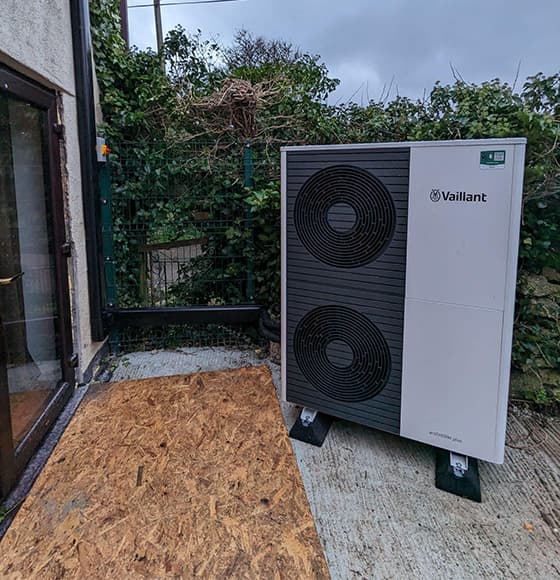
Check that radiators or other parts that give off heat are not blocked by furniture, heavy curtains or stored items. Restricted airflow around a radiator can make it harder for that room to receive heat. Also check the visible area around the outdoor unit: it needs clear space for air to move through it. You can remove loose debris nearby, but do not open the unit or interfere with its components.
If one room stays noticeably cooler while the rest of the home is comfortable, that is useful information. It may point to a room-level issue, a control setting or an issue with how heat is distributed through the system. It does not, by itself, identify the cause. Record which rooms are affected and whether the problem is constant or changes when the heating runs.
Make changes one at a time
If you adjust a normal user control, change only one setting and observe the result. Write down the original setting first so you can restore it if needed. Avoid repeatedly raising the target temperature to force a quick response. If the home is not warming as expected, increasing the demand may not address the underlying reason.
Pay attention to patterns rather than one isolated reading. Note any fault messages, the system starting and stopping unusually often, changes in comfort or a rise in electricity use that cannot be explained by other household use. These details help an engineer distinguish a control issue from a problem that needs inspection.
Know when to stop checking
Leave electrical components, parts containing refrigerant (the fluid that transfers heat) and internal adjustments to a suitably qualified professional. Do not remove covers or attempt repairs. Contact an engineer if a fault message keeps returning, you notice a leak, the system repeatedly stops and starts, or the home no longer reaches its usual comfort level.
Routine professional attention can help identify issues that are not visible from the controller or around the outdoor unit. If a change to settings seems necessary, it is better to understand how it affects the whole system than to keep experimenting. Our AI Air Source Heat Pump Controls service may also be relevant if you want to discuss the way your controls are managing heating.
For an overview of our Heat Pump Installation service, you can read more on the service page. At Smart Renewables & Heating Ltd, we work with homeowners across Sheffield and surrounding areas, and can help you understand whether a control concern needs a closer look.
Other Articles